
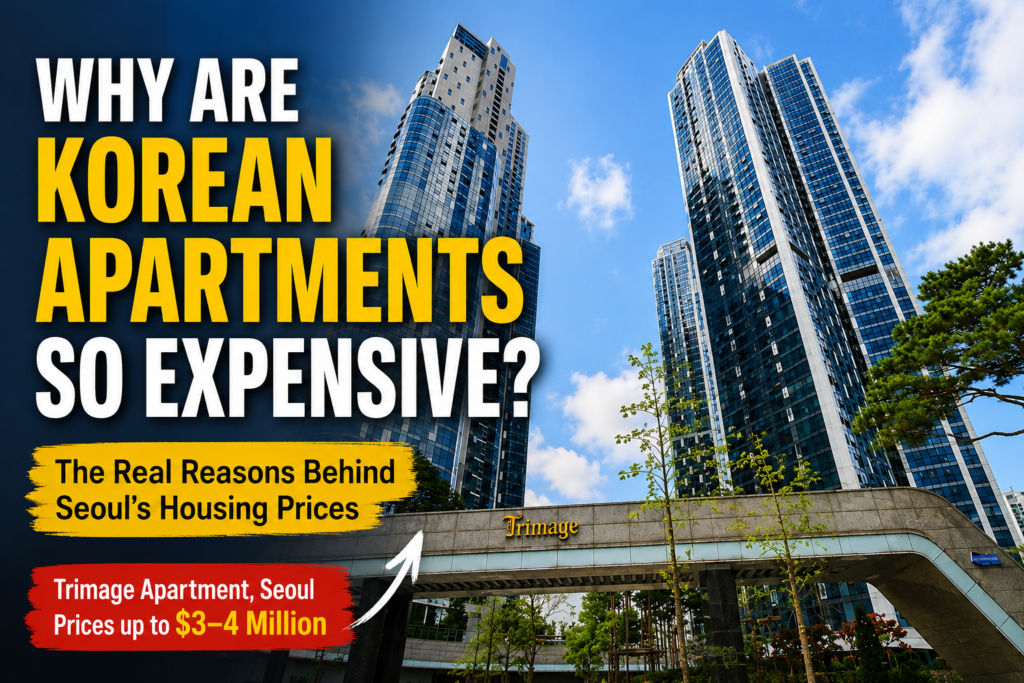
The Real Reasons Behind Seoul’s Housing Prices
One of the biggest surprises for foreigners visiting Korea is apartment prices.
Take a look at neighborhoods like Gangnam, Jamsil, Yongsan, Hannam-dong, or Daechi-dong, and you’ll probably have the same reaction many visitors do:
“Wait… that’s the price of an apartment?”
Honestly, I understand the confusion.
In many countries, the most expensive properties are usually mansions, waterfront homes, or luxury estates.
But in Seoul, a single apartment can be worth several million dollars.
Some luxury apartments owned by celebrities, business executives, and public figures are worth more than large houses in many other countries.
At first glance, people often assume there must be a simple explanation.
“Isn’t it just real estate speculation?”
The reality is much more complicated.
Here’s something many foreigners find surprising.
Not everyone living in an expensive apartment is rich in cash.
Over the past several decades, property values in Korea have risen dramatically. Many homeowners became wealthy on paper because their homes increased in value.
That doesn’t necessarily mean they have millions sitting in their bank accounts.
To understand Korean apartment prices, you first need to understand modern Korean society.
Korea Has Limited Buildable Land
One of the simplest explanations is geography.
Around 70% of South Korea is covered by mountains.
Whenever I mention this to foreign friends, they’re usually surprised.
But once you travel around Korea, you start noticing it everywhere.
Mountains in Busan.
Mountains in Daegu.
Mountains in Daejeon.
And even mountains in Seoul.
Seoul is one of the world’s largest cities, yet you can still see mountains from many parts of the city.
Korea is a country where urban life and nature exist side by side.
The challenge is that flat land is limited.
The population grows.
Businesses expand.
Office buildings increase.
Commercial districts get larger.
But the amount of land stays the same.
Instead of expanding outward, Korea chose to build upward.
That decision helped create the apartment-focused housing culture we see today.
Everyone Wants to Live Near Seoul
If there is one keyword that explains Korean real estate, it is Seoul.
The country’s largest companies.
The best universities.
Major hospitals.
Government agencies.
Cultural attractions.
High-paying jobs.
Many of them are concentrated in Seoul and the surrounding metropolitan area.
I often hear the same story from friends living outside the capital region.
They want to work in Seoul.
They want better career opportunities.
They want access to larger companies.
Then they start looking at housing prices.
The deposit.
The monthly rent.
The apartment prices.
Suddenly, moving to Seoul becomes much more difficult.
The Korean government has spent years trying to reduce this concentration.
One notable example was moving many government ministries from Seoul and Gwacheon to Sejong City.
The goal was simple: reduce pressure on the capital region.
Yet demand for Seoul remains incredibly strong.
Education Matters More Than Many Foreigners Expect
This may be one of the most surprising aspects of Korean society.
Korean parents care deeply about education.
Sometimes, very deeply.
While traveling in Hong Kong, I remember noticing a similar atmosphere. More recently, China has also become known for intense educational competition.
But Korea has been living with this reality for decades.
In Korea, moving to a different neighborhood for better schools is completely normal.
Daechi-dong.
Mok-dong.
Junggye-dong.
Bundang.
These areas are famous not because the buildings are necessarily better.
They are famous because of education.
A strong school district creates demand.
Demand pushes up housing prices.
For many Korean families, buying an apartment is not simply buying a home.
It is also buying access to educational opportunities.
Apartments Became Investment Assets
In many countries, a home is primarily a place to live.
That is true in Korea as well.
But it is also something else.
An investment.
This mindset extends beyond Seoul and into much of the metropolitan area.
For decades, many Koreans watched housing prices rise steadily.
As a result, real estate became one of the most trusted ways to build wealth.
Whether that belief is right or wrong is a separate discussion.
What matters is that millions of people believe it.
And beliefs influence demand.
Demand influences prices.
The Eunma Apartment Example
Few places illustrate this better than Eunma Apartment in Daechi-dong.
The complex was completed in 1979.
That means it is now more than 40 years old.
To be honest, it feels old.
Residents have complained about aging infrastructure.
Some have even reported issues such as rusty water pipes.
So why is it still so expensive?
That question confuses many foreigners.
The answer is that buyers are often paying for the future, not the present.
What if the complex is redeveloped?
What if the location remains highly desirable?
What if the educational advantages remain intact?
Those expectations are reflected in today’s prices.
Eunma Apartment is not just a residential complex.
It is one of the clearest examples of how Korean real estate psychology works.
Supply Is Not As Simple As It Sounds
Foreign visitors often ask a reasonable question.
“Why don’t they just build more apartments?”
The answer sounds simple.
The reality is not.
Redevelopment rules.
Floor-area ratio limits.
Transportation infrastructure.
School capacity.
Resident approval.
Government regulations.
Politics.
Everything is connected.
Build too quickly and people worry about housing prices surging.
Build too slowly and supply shortages become worse.
The interests involved are incredibly complicated.
That is why increasing housing supply is much harder than it appears.
Why Many Koreans Still Dream of Owning an Apartment
Even today, many Koreans share a similar dream.
“I wish I could own just one apartment in Seoul.”
This isn’t necessarily about becoming rich.
It is about stability.
Opportunity.
Education.
And creating a secure future for your family.
In some countries, renting for life is completely normal.
Korea is different.
For many people, homeownership remains one of life’s biggest goals.
I was fortunate enough to buy a home in Seoul myself.
Because of that experience, I understand something many foreigners often miss.
Most Koreans are not dreaming about luxury.
They are dreaming about security.
That feeling is one reason apartments remain so important in Korean society.
Final Thoughts
Korean apartment prices are not simply about housing.
They reflect limited land.
The concentration of people and jobs around Seoul.
Educational competition.
Investment culture.
And decades of social change.
Understanding Korean apartment prices is, in many ways, understanding modern Korea itself.
Complicated?
Absolutely.
But that complexity is also what makes Korea such a fascinating country.
And perhaps that is why so many foreigners keep asking the same question:
Why do Koreans care so much about apartments?
The answer tells you far more about Korea than you might expect.