
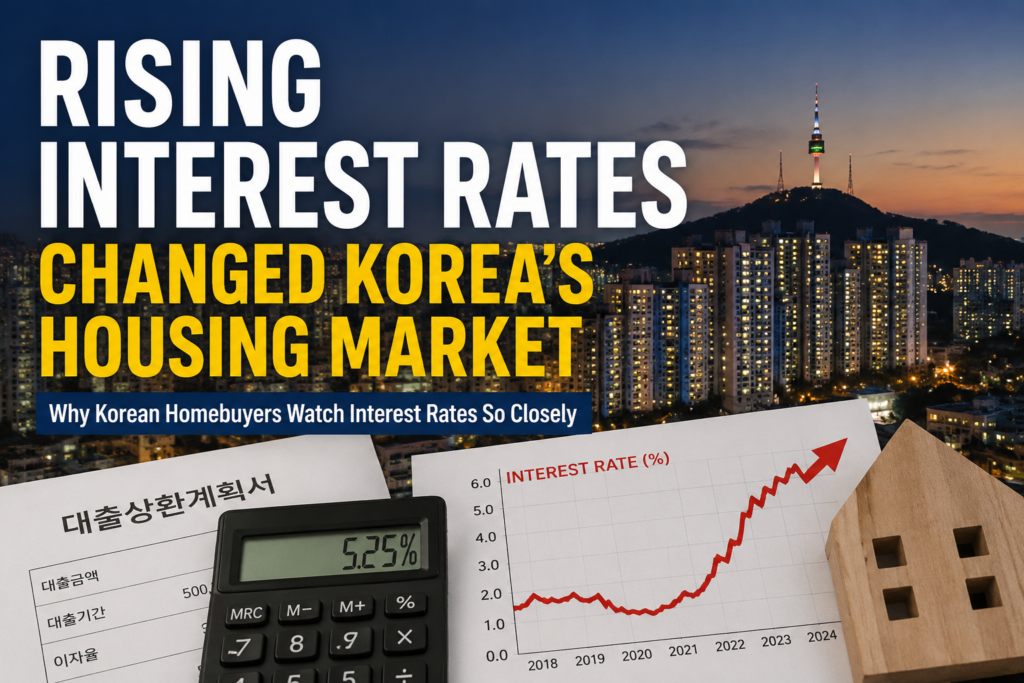
Why Korean Homebuyers Watch Interest Rates So Closely
When Koreans talk about real estate, they don’t just talk about housing prices.
They talk about interest rates too.
In fact, there are times when interest rate news feels even scarier than apartment price news.
The reason is simple.
A large number of Korean households rely on mortgage loans.
To many foreigners, Korea’s obsession with interest rates can seem unusual.
But Korea’s economic story is unique.
The country achieved remarkable growth in a relatively short period of time. That success brought many benefits, but it also created new challenges.
Housing prices.
Interest rates.
Exchange rates.
These numbers are not abstract economic indicators for most Koreans.
They are part of everyday life.
In some ways, Koreans experience economics through their monthly expenses rather than through textbooks.
Korea Experienced a Period of Very Low Interest Rates
Many people remember the COVID-19 period as the era of ultra-low interest rates.
But the story actually started before the pandemic.
For years, it was common for homebuyers to borrow a large percentage of a property’s value.
In some periods, loan-to-value ratios of 70% or even 80% were not unusual.
A typical strategy looked something like this.
Buy an apartment using a mortgage.
Rent it out through Korea’s unique Jeonse system.
Use the Jeonse deposit to help purchase another property.
At the time, this approach felt perfectly normal.
Borrowing money was relatively cheap.
Housing prices kept rising.
Many believed property values would continue climbing indefinitely.
Looking back, it is easy to understand why people felt that way.
COVID-19 accelerated this trend even further.
Massive global liquidity and historically low interest rates pushed housing prices higher around the world, and Korea was no exception.
Then Everything Changed
After 2022, the environment shifted dramatically.
Inflation surged worldwide.
The U.S. Federal Reserve began raising interest rates aggressively.
The Bank of Korea followed with its own rate increases.
At the same time, Korea strengthened various mortgage regulations.
The goal was not only to control inflation but also to prevent excessive risk in the housing market.
Suddenly, borrowing money became much more expensive.
And that changed everything.
A Real Example
To understand why interest rates matter, let’s look at a simple example.
Imagine a homebuyer with a mortgage of 500 million KRW.
At a 2% interest rate, the monthly payment might feel manageable.
Many people viewed the interest expense as part of a long-term investment.
After all, if housing prices continued rising, the loan cost seemed worthwhile.
But what happens when rates move above 5%?
The monthly payment can increase by hundreds of dollars every month.
For salaried workers, that difference can be painful.
Money that once went toward savings, education, travel, or daily expenses is now used to cover interest payments.
The apartment price may not have changed.
But the cost of owning it certainly has.
Korea also has a mix of fixed-rate and variable-rate mortgages, meaning many households feel the impact of rate increases directly.
Why Housing Prices Slowed Down
As borrowing costs increased, buyer behavior changed.
Higher mortgage payments reduced affordability.
Potential buyers became more cautious.
Transaction volumes fell.
Demand weakened.
Government policy also played an important role.
Remember the period when borrowing 70% to 80% of a property’s value was relatively common?
That environment no longer exists in the same way.
Today, many buyers focus on a different question.
“How much can I actually borrow?”
Rather than asking whether they want to buy a home, they first need to determine whether financing is possible.
That shift alone changed the housing market significantly.
Jeonse Was Also Affected
This is a part many foreigners do not realize.
Interest rates also affect Jeonse.
If you have not read my previous article explaining Korea’s Jeonse system, I highly recommend starting there.
In simple terms, Jeonse allows a tenant to provide a large deposit—often 70% to 90% of the property’s value—in exchange for living in the home without monthly rent for about two years.
At the end of the contract, the landlord returns the deposit.
Because Jeonse deposits are closely tied to housing values and financial conditions, changes in interest rates influence the Jeonse market as well.
When interest rates rise, the economics of Jeonse change for both landlords and tenants.
That is one reason housing discussions in Korea almost always involve interest rates.
Why Koreans Watch Interest Rates So Closely
To understand this, you need to understand Korea’s economy.
Korea has relatively few natural resources.
The country built its success through manufacturing, exports, technology, and global trade.
With a population of roughly 50 million people, relying solely on domestic consumption is difficult.
As a result, Korea is highly connected to the global economy.
Exports to countries such as the United States and China remain critically important.
This is why Koreans pay close attention to decisions made by the U.S. Federal Reserve.
When the Fed raises interest rates, the Bank of Korea often faces pressure to respond.
Interest rates affect capital flows.
Exchange rates.
Inflation.
And ultimately, the housing market.
For many Koreans, a Federal Reserve meeting is not just an American event.
It can directly affect mortgage payments, housing affordability, and even the value of the Korean won.
Final Thoughts
In Korea, interest rates are not just financial news.
They influence housing prices.
Jeonse deposits.
Monthly rent.
Household debt.
Consumer spending.
And family finances.
That is why headlines about the U.S. Federal Reserve receive so much attention in Korean media.
A policy decision in Washington can eventually affect a family living in Seoul, Busan, or Daegu.
When I was younger, I thought housing prices were the most important number in the real estate market.
As I got older, I realized something else.
Interest rates often matter just as much.
A house price may stay the same, but if borrowing costs double, the home can suddenly become much more expensive.
That lesson helps explain not only Korea’s housing market, but also why so many Koreans pay such close attention whenever central banks make decisions.
And perhaps that is one of the most important things foreigners should understand about modern Korea.