
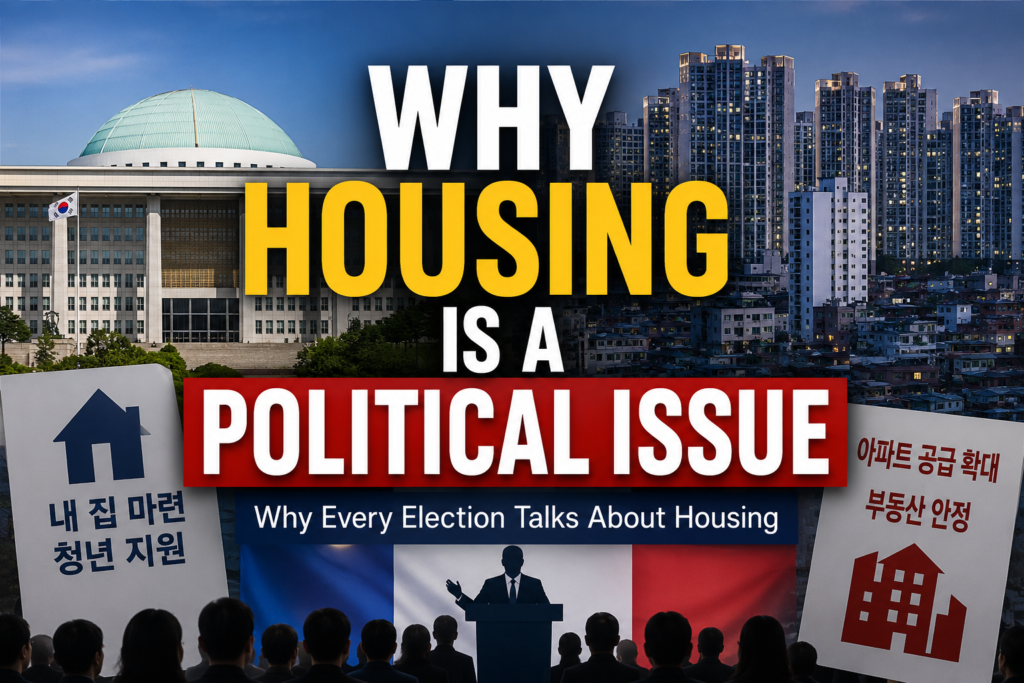
Why Every Election Seems To Be About Housing
Foreigners who follow Korean news often notice something unusual.
Whenever an election approaches, politicians start talking about housing.
Apartments.
Jeonse.
Redevelopment.
Mortgage regulations.
Housing supply.
The topic never seems to disappear.
Why?
Because in Korea, housing is not just about real estate.
A home is often connected to wealth, education, retirement planning, family stability, and future opportunities.
To understand Korean politics, you first need to understand why housing matters so much.
Housing Affects Almost Everyone
One reason housing becomes a political issue is simple.
Almost everyone is affected by it.
People who own homes.
People who rent through Jeonse.
People who pay monthly rent.
Young adults looking for their first home.
Retirees worried about their housing assets.
No matter where you stand, housing affects your daily life.
That makes it one of the few issues that nearly every voter cares about.
Seoul’s Housing Prices Became A National Issue
Another reason is Seoul.
Housing prices in neighborhoods such as Gangnam, Jamsil, Yongsan, and Daechi-dong often become national news.
This can seem strange to foreigners.
Why would apartment prices in one city dominate the national conversation?
The answer is that Seoul is more than just a city.
It is the center of jobs, education, business, culture, and opportunity.
When housing prices rise in Seoul, people across the country pay attention.
Even those who live hundreds of kilometers away may worry about whether their children will eventually be able to afford housing in the capital region.
Young People Feel Locked Out
This is where the issue becomes emotional.
For many young Koreans, homeownership feels increasingly difficult.
When people in their twenties move to Seoul from other regions, they rarely start their lives in luxury apartments.
Many live in small studio apartments near areas such as Sillim, Hongdae, or university districts.
Some live in officetels.
Others rent tiny rooms in older residential neighborhoods.
While the government and local governments provide various youth housing programs, many young people still feel financial pressure.
Because of this, young adults from outside Seoul often envy friends whose parents already own homes in the capital.
The gap can feel enormous.
The challenge becomes even more visible in your thirties.
This is often the stage when people start thinking seriously about marriage, children, and buying a home.
But Korea’s job market is highly competitive.
Even after finding what many would consider a good job, the numbers can be discouraging.
Imagine earning a monthly salary of 3 million KRW.
After deductions for pension contributions, health insurance, employment insurance, income tax, and local income tax, take-home pay can fall to roughly 2.66 million KRW.
Then come the real expenses.
Rent.
Transportation.
Food.
Utilities.
Mobile phone bills.
And for some people, financial support for parents.
A monthly housing cost of 800,000 KRW is not unusual in Seoul.
After paying living expenses, saving for a home can feel painfully slow.
Now compare that reality to apartment prices that often start above 500 million KRW and climb much higher in popular areas.
This helps explain why housing becomes such an important political issue.
For many young people, it is not simply about buying property.
It is about whether entering the housing market is realistically possible.
Homeowners And Renters Want Different Things
Housing policy is difficult because different groups want different outcomes.
Homeowners often want housing values to remain stable or increase.
Renters often hope prices become more affordable.
Policies that help one group may frustrate another.
As a result, housing debates quickly become political debates.
Finding a solution that satisfies everyone is almost impossible.
Every Government Promises Housing Solutions
This is why housing appears in nearly every election.
Presidential elections.
National Assembly elections.
Mayoral elections.
Housing promises are everywhere.
Build more homes.
Reduce housing prices.
Support young buyers.
Expand public housing.
Reform redevelopment rules.
Every administration offers a different approach.
Yet housing remains one of Korea’s most persistent challenges.
Why Housing Is More Than Housing
For many Koreans, a home represents much more than a place to live.
Housing often means:
- Wealth
- Education
- Retirement security
- Family stability
- Future opportunity
That is why conversations about housing can become so emotional.
People are not simply discussing buildings.
They are discussing their future.
Final Thoughts
Housing is not just a real estate issue in Korea.
It is one of the most important social, economic, and political issues in the country.
It affects young adults trying to build a future.
Families making educational decisions.
Retirees protecting their savings.
And governments trying to balance competing interests.
That is why housing never disappears from Korean politics.
And perhaps that is the most important thing foreigners should understand.
When Koreans debate housing, they are often debating something much bigger than apartments.
They are debating opportunity itself.