
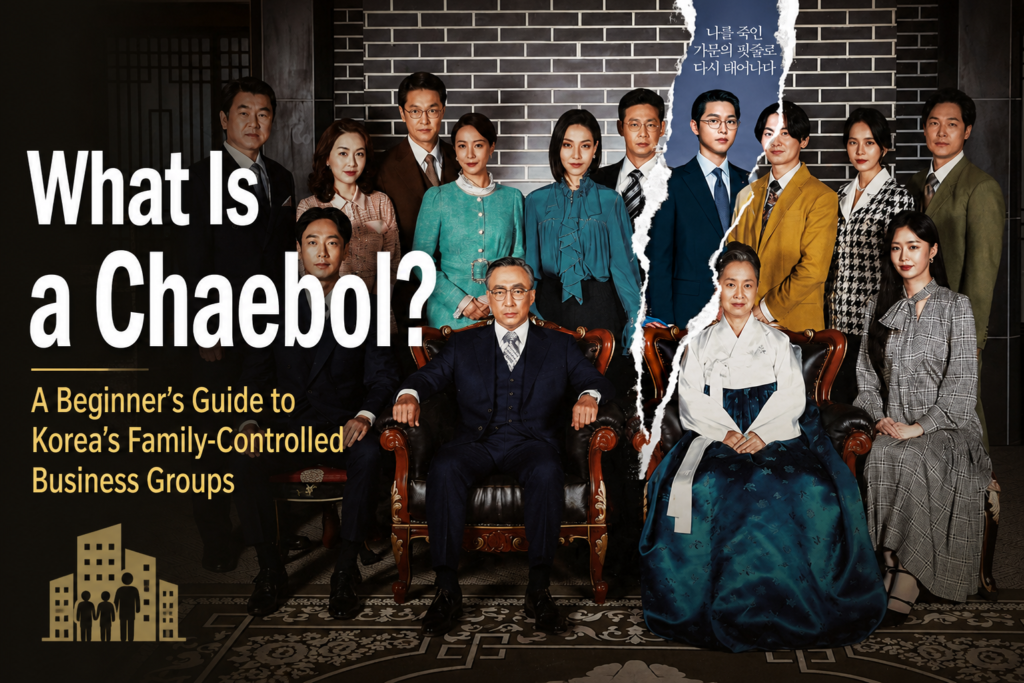
A Beginner’s Guide to Korea’s Family-Controlled Business Groups
South Korea is home to some of the world’s most recognizable companies. Samsung, Hyundai, LG, SK, and Lotte have become global brands, selling everything from smartphones and cars to batteries, ships, and chemicals.
If you spend enough time reading about Korea, you will eventually come across a word that rarely appears in discussions about other developed economies: chaebol.
Many people assume a chaebol is simply a large company. In reality, it is much more than that.
A chaebol is a unique business structure that has shaped South Korea’s economy for more than half a century. It explains why a handful of business groups have such a significant influence on the country’s exports, stock market, employment, and even public policy.
To understand modern Korea, you first need to understand what a chaebol is.
What Does “Chaebol” Mean?
The word chaebol (재벌) is made up of two Korean words.
- Jae (재) means wealth.
- Beol (벌) refers to a family, faction, or group.
Today, however, the meaning goes far beyond its literal translation.
A chaebol is a large business group made up of many affiliated companies that are ultimately controlled by a founding family. Unlike a single corporation, a chaebol is a network of businesses operating across multiple industries while remaining connected through ownership structures and long-term family influence.
For example, when people hear the name “Samsung,” they often think only of Samsung Electronics. In reality, Samsung is a business group that includes companies in electronics, construction, insurance, biotechnology, engineering, and other sectors.
This type of corporate structure is one of the defining characteristics of South Korea’s economy.
Why Did Chaebols Become So Powerful?
The rise of chaebols cannot be understood without looking at Korea’s modern history.
When the Korean War ended in 1953, South Korea was one of the poorest countries in the world. Much of its infrastructure had been destroyed, industrial production was limited, and the country faced enormous economic challenges.
Beginning in the 1960s, the Korean government adopted an export-oriented industrialization strategy. Instead of spreading limited resources across thousands of small businesses, policymakers focused on supporting companies that showed the potential to compete internationally.
These companies received easier access to financing, government-backed development programs, and opportunities to expand into strategic industries such as electronics, automobiles, shipbuilding, steel, construction, and chemicals.
As these businesses succeeded overseas, they reinvested their profits, entered new industries, and continued to grow. Over time, many evolved into the large business groups now known as chaebols.
Companies such as Samsung, Hyundai, LG, and SK became symbols of South Korea’s remarkable economic transformation.
Within just a few decades, the country moved from widespread poverty to becoming one of the world’s leading manufacturing and technology economies. The growth of chaebols was not the only reason for this transformation, but it was undoubtedly one of its most important driving forces.
Korea’s Rapid Growth Came with Challenges
South Korea’s economic development is often described as the “Miracle on the Han River.” It lifted millions of people out of poverty and transformed the country into one of Asia’s largest economies.
However, rapid growth also created difficult challenges.
As governments worked closely with large business groups to accelerate industrialization, the relationship between political leaders and major corporations sometimes became too close. Over the decades, Korea experienced several high-profile corruption scandals involving business executives and political figures.
Critics also argued that economic power became concentrated in the hands of a relatively small number of business groups, making it harder for smaller companies to compete on equal terms.
At the same time, many Koreans recognize that these same companies played a critical role in rebuilding a country devastated by colonial rule, war, and poverty. They created millions of jobs, expanded exports, introduced advanced technologies, and helped raise living standards across the nation.
Because of this history, chaebols remain one of the most debated subjects in Korean society.
Many people admire their contribution to economic growth while also supporting reforms that promote greater transparency, stronger corporate governance, and fairer competition.
This balance between economic success and structural reform continues to shape discussions about Korea’s future.
Is Samsung Just One Company?
One of the biggest misconceptions about South Korea is that Samsung is simply Samsung Electronics.
In reality, Samsung Electronics is only one company within the much larger Samsung Group.
The Samsung Group includes businesses operating in a wide range of industries, including construction, engineering, insurance, biotechnology, IT services, and investment.
Some well-known Samsung affiliates include:
Samsung Electronics
Samsung C&T
Samsung Life Insurance
Samsung SDS
Samsung Biologics
Many of these companies are publicly listed and operate independently. They have different management teams, financial statements, and shareholders.
However, they are still recognized as part of the same business group because of their historical ownership structure and family control.
The same pattern can also be seen in other Korean chaebols.
For example, Hyundai Motor Group includes Hyundai Motor, Kia, Hyundai Mobis, Hyundai Engineering & Construction, and several other affiliated companies.
Understanding this structure helps explain why the word “chaebol” refers to a business group rather than a single corporation.
Why Are Chaebols So Important?
Chaebols have played a central role in South Korea’s economic development for more than half a century.
Their influence extends far beyond individual companies.
Today, chaebol-affiliated businesses account for a significant share of Korea’s exports, manufacturing output, research and development, and stock market value.
Many of the country’s largest employers also belong to major business groups.
As a result, the performance of leading chaebols often affects investor confidence, employment trends, and the overall economy.
When Samsung Electronics reports strong earnings, investors frequently see it as a positive signal for South Korea’s economy.
Likewise, developments at Hyundai, SK, LG, or other major groups often receive nationwide attention because their businesses influence suppliers, consumers, employees, and financial markets.
This is one reason why business news occupies such an important place in Korean media.
Many Koreans own shares of large companies directly or indirectly through pension funds and investment products, making the performance of chaebols relevant to everyday life.
Why Are Chaebols Sometimes Criticized?
Although chaebols contributed significantly to South Korea’s economic success, they have also been the subject of ongoing public debate.
Supporters argue that these business groups transformed a country devastated by war into one of the world’s leading economies.
They point to achievements such as:
Creating millions of jobs
Building globally competitive brands
Expanding Korea’s exports
Investing heavily in research and innovation
Raising living standards over several decades
These accomplishments are difficult to overlook.
At the same time, critics believe the concentration of economic power has created long-term structural challenges.
Common concerns include:
Complex ownership structures that can make corporate governance difficult to understand.
A high concentration of economic influence among a relatively small number of business groups.
Challenges faced by smaller businesses when competing with dominant conglomerates.
The close relationship that has sometimes existed between business leaders and political institutions.
Over the years, South Korea has introduced various corporate governance reforms and competition policies aimed at improving transparency and creating a more level playing field.
The debate today is no longer about whether chaebols should exist.
Instead, it focuses on how these companies can continue contributing to economic growth while improving accountability, governance, and fair competition.
Conclusion
Chaebols are one of the defining features of South Korea’s economy.
They are much more than large corporations.
They are business groups that have shaped the country’s industrial development, global competitiveness, and economic success for generations.
At the same time, they remain an important subject of discussion because their influence reaches far beyond the business world.
Understanding chaebols means understanding both the strengths and the challenges of Korea’s remarkable economic journey.
Whether you are interested in investing, doing business in Korea, or simply learning more about the country, understanding how chaebols work provides valuable insight into modern Korean society.
Quick Summary
| Question | Answer |
|---|---|
| What is a chaebol? | A large family-controlled business group made up of multiple affiliated companies. |
| Why did chaebols become powerful? | Government-led industrialization, export growth, and decades of business expansion helped them grow rapidly. |
| Is Samsung a chaebol? | Yes. Samsung Group is one of South Korea’s largest chaebols, and Samsung Electronics is only one of its affiliated companies. |
| Why are chaebols important? | They contribute significantly to exports, employment, manufacturing, technology, and the stock market. |
| Why are they criticized? | Concerns include concentrated economic power, corporate governance, market competition, and transparency. |
Frequently Asked Questions
Are chaebols unique to South Korea?
Large business groups exist in many countries, but South Korea’s chaebol system is unique because of its historical development, family control, and close connection to the country’s rapid industrialization.
Is every large Korean company a chaebol?
No.
Many successful Korean companies are not classified as chaebols. The term generally refers to large family-controlled business groups with multiple affiliated companies.
Why do foreign investors pay attention to chaebols?
Because many of Korea’s largest listed companies belong to chaebol groups, their financial performance can influence the Korean stock market and broader economy.
Will chaebols continue to dominate Korea’s economy?
Chaebols remain highly influential, but South Korea’s economy is also changing.
Technology startups, biotechnology companies, semiconductor suppliers, and globally competitive small and medium-sized businesses are playing increasingly important roles alongside traditional business groups.
Official Sources
For readers who would like to explore further, the following official organizations provide reliable information about Korea’s economy and corporate environment.
Bank of Korea (BOK)
Korea Fair Trade Commission (KFTC)
Korea Exchange (KRX)
Statistics Korea (KOSTAT)