
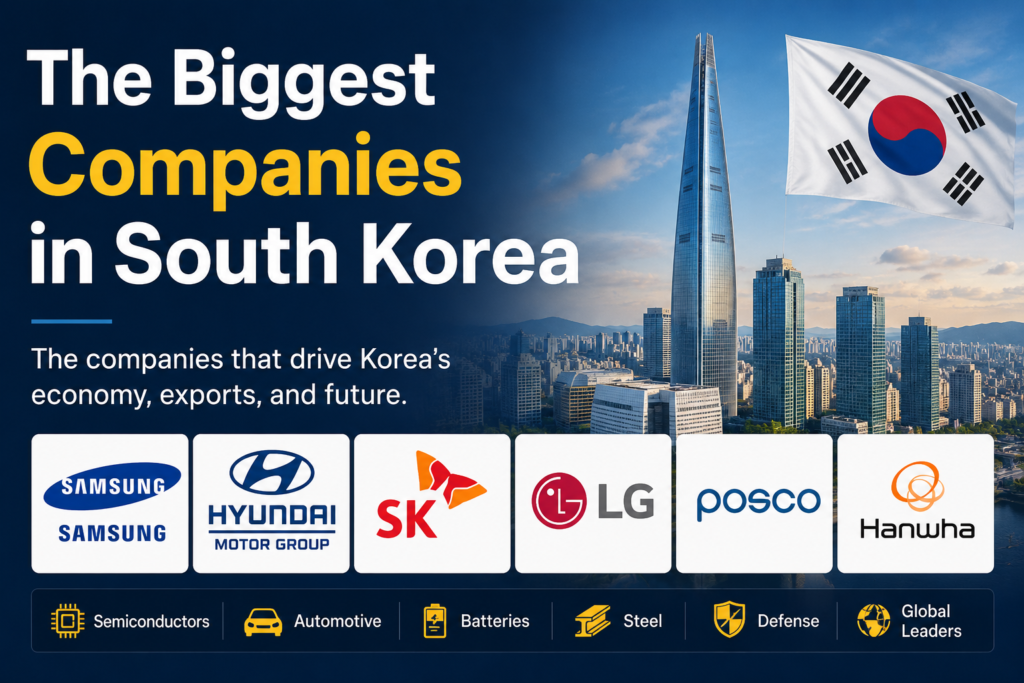
Meet the Companies That Shape Korea’s Economy, Global Exports, and Everyday Life
When people think about South Korea, they usually think of Samsung.
But Samsung is only part of the story.
South Korea is home to some of the world’s most competitive companies. From automobiles and semiconductors to batteries, shipbuilding, steel, and defense, these businesses have helped transform a country with few natural resources into one of the world’s largest exporting economies.
Understanding these companies is one of the best ways to understand modern Korea.
1. Samsung
Main Businesses
Electronics
Semiconductors
Smartphones
Home Appliances
Well-known Brands
Galaxy
Samsung TVs
Memory Chips
Samsung is one of the world’s largest technology companies and a global leader in memory semiconductors.
For many international visitors, Samsung is the first Korean brand that comes to mind.
TedChang’s View
Samsung is no longer just a smartphone company.
Its real strength lies in controlling technologies that power AI servers, smartphones, home appliances, and advanced semiconductor manufacturing.
As artificial intelligence continues to expand, semiconductors have become the foundation of the digital economy. If chips are the “brains” of AI, Samsung is one of the companies helping build those brains.
Samsung’s influence extends far beyond consumer electronics.
2. Hyundai Motor Group
Main Businesses
Hyundai
Kia
Genesis
Hyundai Motor Group is one of the world’s leading automobile manufacturers.
The company continues to invest heavily in electric vehicles (EVs), hydrogen mobility, and autonomous driving technologies.
TedChang’s View
One of the biggest reasons global investors are watching Hyundai today is Physical AI.
Unlike many technology companies, Hyundai has spent decades building factories, optimizing production lines, and collecting real-world manufacturing data.
Following its expansion into robotics through strategic acquisitions and investments, Hyundai is increasingly viewed as a company capable of combining AI with physical manufacturing.
Physical AI is about more than robots. It is about enabling machines to understand and perform real-world tasks in factories and industrial environments.
Hyundai already owns one of the world’s largest manufacturing classrooms.
3. SK Group
Main Businesses
Semiconductors
Energy
Telecommunications
SK Group operates across several industries, but its semiconductor business has attracted the most global attention in recent years.
SK hynix is now one of the world’s largest memory chip manufacturers, while SK Telecom remains one of Korea’s leading telecommunications companies.
TedChang’s View
Perhaps the biggest story inside SK today is SK hynix.
The AI boom has dramatically increased demand for High Bandwidth Memory (HBM), one of the most important components used in AI accelerators.
As demand for AI chips has exploded, SK hynix has emerged as one of the world’s leading HBM suppliers.
Not long ago, Samsung clearly dominated the memory industry.
Today, many global investors view SK hynix as competing on nearly equal footing in the AI semiconductor race.
That shift says a great deal about how quickly leadership can change in the technology industry.
4. LG
Main Businesses
Electronics
Batteries
Chemicals
LG Energy Solution is one of the world’s leading electric vehicle battery manufacturers.
LG Electronics is well known for premium televisions, home appliances, and display technologies.
TedChang’s View
Many people associate LG with televisions and refrigerators.
I see another long-term opportunity.
HVAC (Heating, Ventilation, and Air Conditioning).
As AI data centers continue to expand and global temperatures rise, demand for high-efficiency cooling systems is expected to grow rapidly.
Cooling has become one of the biggest challenges for AI infrastructure.
LG has spent decades developing commercial air-conditioning and HVAC technologies, making it a company worth watching far beyond traditional consumer electronics.
5. POSCO
POSCO is one of the world’s leading steel manufacturers.
Its products are widely used in
Automobiles
Shipbuilding
Construction
Semiconductor manufacturing facilities
The company is also expanding into battery materials to support the growing electric vehicle industry.
TedChang’s View
Steel may sound like an old industry.
In reality, every semiconductor factory, AI data center, offshore wind project, and modern manufacturing plant begins with steel.
Without materials, there is no manufacturing.
POSCO remains one of the companies supporting Korea’s industrial foundation while adapting to new industries such as battery materials and advanced manufacturing.
6. Hanwha
Main Businesses
Defense
Aerospace
Solar Energy
Shipbuilding
Hanwha has become one of Korea’s fastest-growing industrial groups.
Its businesses now span renewable energy, aerospace, defense, and heavy industries.
TedChang’s View
Many international readers may not realize one important fact.
South Korea is technically still at war.
The Korean War ended with an armistice in 1953—not a peace treaty.
Because of this unique security environment, defense has remained a long-term national priority.
Government investment in defense technology, missile systems, naval capabilities, aerospace, and military equipment has continued for decades.
This helps explain why Hanwha has become an increasingly important global defense company.
To understand Korea’s defense industry, you must first understand Korea’s geopolitical reality.
7. Other Major Companies
South Korea’s economy extends well beyond its largest conglomerates.
Other influential companies include:
Kakao
Naver Celltrion
Doosan
HD Hyundai
These companies are leaders in
Internet platforms
E-commerce
Biotechnology
Heavy machinery
Shipbuilding
Industrial equipment
TedChang’s View
Twenty years ago, Korea’s economy was largely associated with electronics and automobiles.
Today, global investors are also paying attention to AI platforms, biotechnology, logistics, robotics, defense, shipbuilding, and smart manufacturing.
Modern Korea is no longer driven by a single industry.
It is supported by a diverse industrial ecosystem that continues to evolve.
Why Are These Companies So Important?
South Korea is one of the world’s most export-oriented economies.
These companies contribute significantly to
Exports
Employment
Research and Development (R&D)
Stock Market Performance
Global Competitiveness
Many of them are also major components of the KOSPI, meaning their performance often influences the entire Korean stock market.
Understanding these companies is one of the fastest ways to understand how Korea’s economy works.
Conclusion
South Korea’s biggest companies are more than household names.
They represent the country’s industrial history, technological innovation, and global competitiveness.
For many international investors, Samsung may be the starting point.
But to truly understand Korea, it is worth looking beyond a single company.
From semiconductors and automobiles to AI infrastructure, defense, batteries, and advanced manufacturing, each industry tells part of Korea’s economic story.
That is what makes Korea one of the most fascinating economies in the world today.