
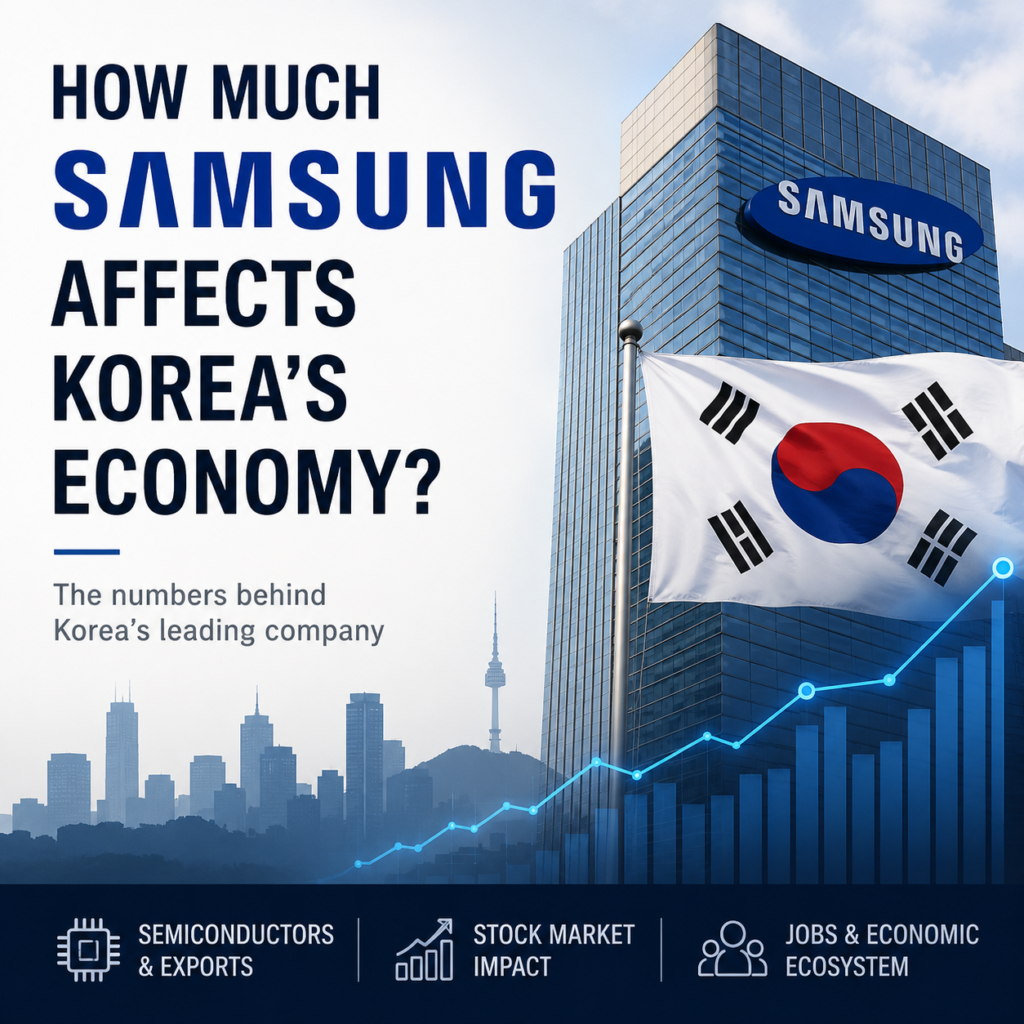
How much does Samsung really matter to South Korea?
When foreigners think about South Korea, one company usually comes to mind first.
Samsung.
For many people, Samsung means smartphones, TVs, and semiconductors.
But for Koreans, Samsung is much more than an electronics company.
It is closely connected to exports, employment, the stock market, technological innovation, and even national confidence.
This raises an interesting question.
How much does Samsung actually affect Korea’s economy?
The short answer is simple.
Samsung is not the Korean economy.
But it is one of the most influential companies shaping it.
Samsung Is Korea’s Largest Listed Company
As of July 2026, Samsung Electronics remains South Korea’s largest publicly listed company by market capitalization.
Its market value stands at approximately ₩1,756 trillion, making it the biggest company listed on the Korea Exchange (KRX).
That fact alone tells an important story.
The Samsung Group includes many other well-known companies, including Samsung C&T, Samsung SDI, Samsung Life Insurance, Samsung Biologics, and Samsung SDS.
However, even without including those affiliates, Samsung Electronics alone remains the country’s largest listed company.
For many overseas readers, “Samsung” sounds like just another global technology brand.
In reality, Samsung Electronics has become one of the key companies used to measure the health of Korea’s stock market and, in many cases, investor confidence in the Korean economy itself.
Samsung Is More Than A Smartphone Company
Many people outside Korea know Samsung because of the Galaxy smartphone.
However, Samsung Electronics generates revenue from a much wider range of businesses.
These include:
Semiconductors
Memory chips
AI and data center components
Displays
Home appliances
Consumer electronics
Network equipment
Today, Samsung is one of the world’s largest semiconductor manufacturers.
Its memory chips are used in smartphones, personal computers, cloud servers, and AI data centers around the world.
As artificial intelligence continues to expand, demand for high-performance semiconductors has become one of Samsung’s biggest growth drivers.
Samsung Plays A Major Role In Korea’s Exports
South Korea is one of the world’s most export-dependent economies.
Products such as automobiles, batteries, ships, steel, and semiconductors account for a large share of the country’s exports.
Among them, semiconductors have become Korea’s single most important export product.
Samsung Electronics is one of the companies leading that industry.
When global demand for semiconductors increases, Samsung’s exports generally increase as well.
When the semiconductor market weakens, Samsung’s earnings often decline.
Because of Samsung’s size, these changes are reflected not only in the company’s financial results but also in Korea’s overall export performance.
For this reason, economists and investors frequently monitor Samsung’s quarterly earnings as an indicator of Korea’s export competitiveness.
Samsung Has A Huge Influence On The Korean Stock Market
Samsung Electronics is also the most influential company in the Korean stock market.
It consistently ranks as the largest company in the KOSPI by market capitalization.
Because of its enormous size, movements in Samsung’s share price often have a significant impact on the overall KOSPI index.
When Samsung’s stock rises sharply, the Korean market often follows.
When Samsung declines significantly, the KOSPI can also weaken.
This is why global investors pay close attention to Samsung’s earnings announcements, semiconductor demand, and future investment plans.
For many international fund managers, Samsung is often the first Korean company they analyze before investing in Korea.
Samsung Supports A Large Industrial Ecosystem
Samsung’s influence extends far beyond its own employees.
Building a semiconductor factory requires:
Construction companies
Equipment manufacturers
Materials suppliers
Software companies
Logistics providers
Engineering firms
Utility infrastructure
Thousands of Korean companies participate in Samsung’s supply chain.
When Samsung announces a large investment in semiconductor production or AI infrastructure, many suppliers also benefit.
This multiplier effect is one reason Samsung’s investment plans receive nationwide attention.
Its business decisions affect not only shareholders but also regional economies and thousands of partner companies.
Samsung Also Influences Employment
Samsung has long been one of Korea’s most desired employers.
Beyond its direct workforce, the company creates employment through suppliers, contractors, logistics companies, retailers, research institutions, and technology partners.
For many Korean families, Samsung represents more than just a workplace.
It represents stable employment, career development, and long-term financial security.
This explains why Samsung’s business performance is closely watched not only by investors but also by ordinary citizens.
Samsung Shapes Korea’s Global Image
Long before K-pop and Korean dramas became global phenomena, Samsung had already introduced Korea to millions of people around the world.
For many international consumers, Samsung was the first Korean brand they recognized.
Just as Toyota helped define Japan’s manufacturing reputation and Apple became a symbol of American innovation, Samsung has become one of the strongest symbols of Korea’s technological competitiveness.
Its global success has strengthened Korea’s image as a country capable of producing world-class technology and innovation.
Samsung Is Not Korea—But It Helps Explain Korea
It would be incorrect to say that Samsung is the Korean economy.
Korea also has globally competitive companies such as Hyundai Motor, SK hynix, LG Energy Solution, POSCO Holdings, Naver, Hanwha, Celltrion, and many others.
Millions of small and medium-sized businesses also play an essential role in the country’s economy.
However, it would be equally incorrect to describe Samsung as simply another large corporation.
Because of its size, global reach, technological leadership, and influence on exports and financial markets, Samsung occupies a unique position within Korea’s economy.
Understanding Samsung helps explain how Korea developed into one of the world’s leading industrial and technology economies.
Conclusion
So, how much does Samsung affect Korea’s economy?
The answer cannot be expressed by a single percentage.
Samsung influences Korea through exports, technology, employment, investment, supply chains, financial markets, and global competitiveness.
Its performance does not determine everything that happens in Korea.
But it often reflects how the country’s most important industries are performing.
For many foreign visitors, Samsung is simply the company that makes Galaxy smartphones.
For Koreans, Samsung represents something much larger.
It is one of the companies that tells the story of modern Korea itself.