
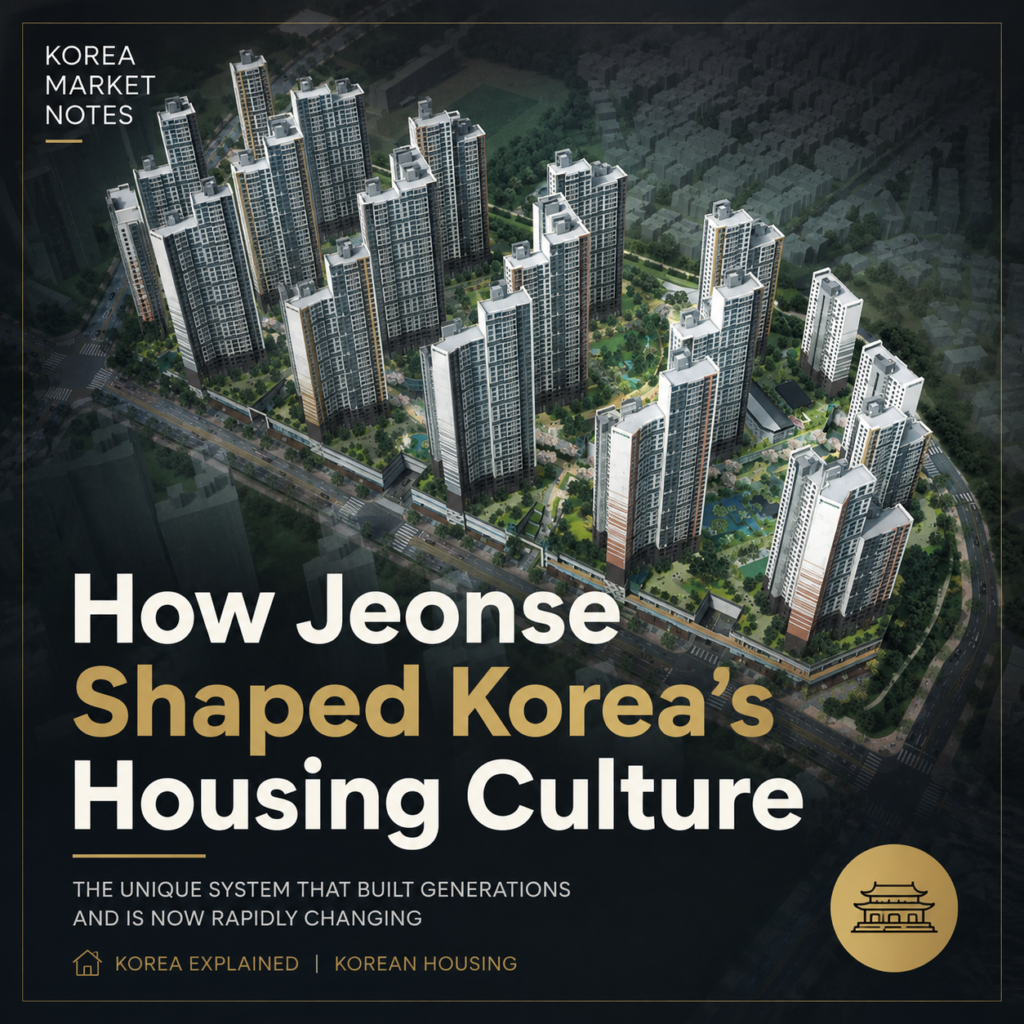
Many foreigners think Jeonse is simply a rental system.
But in Korea, Jeonse did much more than provide housing.
It influenced where people lived, how they saved money, how families planned their future, and even how apartment prices evolved.
To understand modern Korea, you must understand how Jeonse shaped Korean housing culture.
What makes Jeonse even more fascinating is that it is a housing system found almost nowhere else in the world.
Ironically, however, this uniquely Korean system is gradually disappearing.
In recent years, a new housing arrangement called Ban-Jeonse (Half-Jeonse) has become increasingly common. Under this model, tenants pay a smaller deposit and make monthly rent payments for the remaining portion.
The rise of Ban-Jeonse reflects a major shift in Korean housing culture. The system that shaped generations of Koreans is no longer as accessible as it once was.
Jeonse Encouraged Saving Instead Of Borrowing
For decades, Korean households focused on saving rather than borrowing.
Unlike many Western countries where mortgages became the primary path to housing, Koreans often spent years accumulating cash to secure a Jeonse deposit.
Parents saved.
Children saved.
Entire families viewed housing preparation as a long-term financial project.
This culture helped create one of the strongest saving habits in the world.
For many Koreans, there was an unwritten life path:
Wolse (Monthly Rent) → ↓ Jeonseㅍ→ Home Ownership
People did not simply rent a home.
They viewed Jeonse as a stepping stone toward eventually purchasing an apartment.
As a result, home ownership became one of the most important financial goals in Korean society.
Jeonse Helped Apartments Spread Across Korea
As Korea urbanized rapidly, apartment construction expanded across the country.
Jeonse played an important role in that growth.
Large Jeonse deposits provided landlords with access to capital without traditional financing.
Many homeowners used Jeonse deposits to purchase additional properties or fund new investments.
This created a cycle that accelerated apartment development.
As a result, Jeonse became deeply connected to Korea’s apartment-centered housing market.
It is difficult to separate the story of modern Korean apartments from the story of Jeonse.
Jeonse Created A Unique Housing Ladder
In many countries, renting and home ownership are separate stages of life.
Korea developed a unique middle step.
Wolse → Jeonse →Home Ownership
For decades, this housing ladder worked surprisingly well.
A young worker might begin with a small monthly rental apartment.
After years of saving, they could move into a Jeonse property.
Later, accumulated savings and rising property values often made home ownership possible.
This process shaped the financial plans of an entire generation.
For many families, Jeonse was not just a housing contract.
It was part of a life stratey.
Why That Housing Ladder Is Becoming Harder To Climb
Today, the situation looks very different.
Housing prices have risen dramatically, especially since the pandemic years.
Apartment values in Seoul increased much faster than wages.
Jeonse deposits also became larger and more difficult to afford.
For younger generations, the traditional path from Wolse to Jeonse and eventually to home ownership feels increasingly out of reach.
The gap between homeowners and non-homeowners has become more visible.
In many cases, the challenge is no longer buying a home.
The challenge is securing a Jeonse deposit in the first place.
Why Younger Koreans View Jeonse Differently Today
The housing market has changed.
Interest rates are higher than they were in the past.
Living costs continue to rise.
Job security is less predictable than it was for previous generations.
As a result, many younger Koreans no longer view Jeonse the same way their parents did.
For previous generations, Jeonse often represented stability and opportunity.
For younger generations, it can feel like another financial hurdle.
This shift is one of the biggest reasons Korea’s housing culture is evolving.
Monthly rent has become increasingly common, particularly in Seoul and other major cities.
The rise of Ban-Jeonse is another sign of this transition.
The Cultural Impact Still Remains
Even as the housing market changes, the cultural influence of Jeonse remains strong.
Many Koreans still consider Jeonse more stable than monthly rent.
Parents frequently help their children with Jeonse deposits.
Housing discussions often focus on whether someone can afford Jeonse rather than whether they can afford rent.
These attitudes reveal how deeply Jeonse became embedded in Korean society.
For many Koreans, housing is not simply a place to live.
It is closely connected to financial security, family support, and long-term planning.
Final Thoughts
Jeonse is far more than a rental contract.
It helped shape how Koreans save money, plan for the future, and pursue social mobility.
Understanding Jeonse is not only about understanding a housing system.
It is about understanding modern Korean society itself.
Although its influence may gradually decline in the future, Jeonse remains one of the most important concepts in Korean housing.
It is legally protected, widely recognized, and still plays a major role in everyday life.
For decades, Jeonse shaped the dreams of ordinary Korean families.
And even as Korea changes, its influence can still be seen throughout the country today.