
“전세와 월세의 차이, 한국에서 어떤 임대 방식이 나에게 맞을까?”
If you’re planning to live in Korea, one of the first housing decisions you’ll face is choosing between Jeonse (전세) and Wolse (월세).
For many foreigners, this can be confusing. In most countries, renting a home simply means paying rent every month. Korea is different.
Some tenants pay no monthly rent at all. Instead, they provide a large deposit that is returned when the lease ends.
Understanding the difference between Jeonse and Wolse is essential because choosing the wrong option could cost you a significant amount of money.
What Is Jeonse?
Jeonse is a uniquely Korean housing rental system where a tenant pays a large lump-sum deposit to the landlord instead of monthly rent.
The deposit is usually between 50% and 80% of the property’s market value and is returned in full when the lease ends, typically after two years.
In simple terms:
- Large upfront deposit
- No monthly rent
- Deposit returned at the end of the contract
For foreigners, Jeonse often sounds unusual because similar systems rarely exist outside Korea.
What Is Wolse?
Wolse is Korea’s version of a traditional monthly rental system.
Tenants pay a smaller security deposit and a fixed monthly rent.
For example: Smaller upfront deposit
Monthly rent payment
More flexibility
Lower capital requirement
Most foreigners, students, and digital nomads are already familiar with a system similar to Wolse.
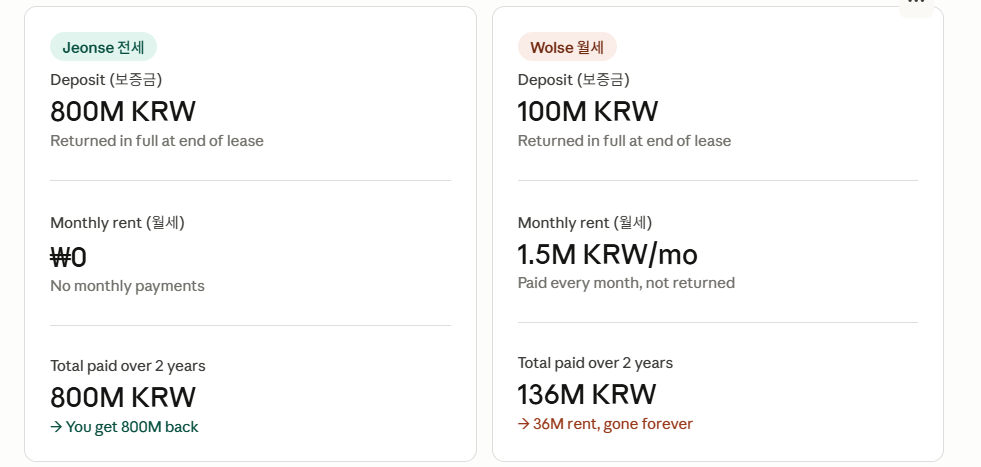
Jeonse vs. Wolse: A Real Numbers Comparison
The numbers below are simplified examples based on common housing situations in Seoul.
Wolse (Monthly Rent)
| Property Type | Deposit | Monthly Rent |
|---|---|---|
| Studio | 10M KRW | 800K KRW |
| Two-room | 20M KRW | 1.2M–1.5M KRW |
| Apartment | 100M KRW | 1.5M KRW+ |
Jeonse
| Property Type | Property Value | Jeonse Deposit | Monthly Rent |
|---|---|---|---|
| Apartment | 1B KRW | 700M–900M KRW | 0 |
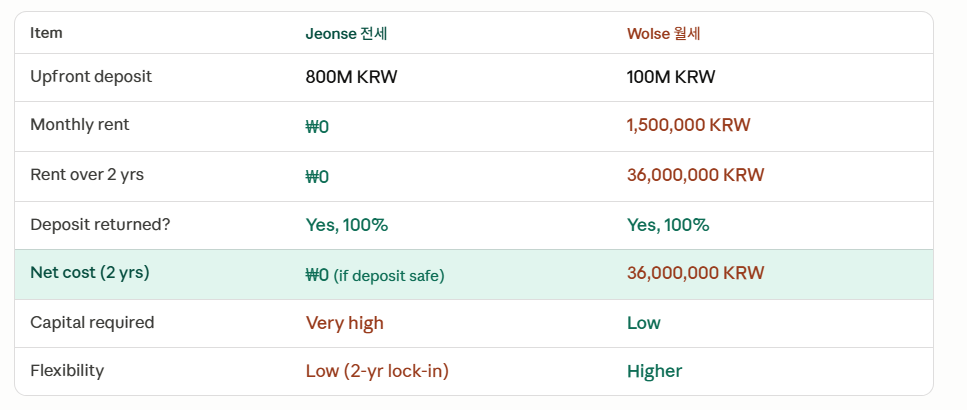
The key difference is simple.
Wolse requires less cash today but creates a monthly expense.
Jeonse requires significantly more capital upfront but eliminates monthly rent.
Why Do Koreans Choose Jeonse?
For decades, Jeonse made practical and financial sense for many Korean households.
Housing Stability
Tenants enjoy relatively stable housing costs during the lease period.
Savings-Oriented Culture
Many Koreans view Jeonse as a stepping stone toward homeownership because the deposit is returned at the end of the contract.
Historical Background
During Korea’s rapid economic growth in the 1970s and 1980s, landlords often used tenant deposits as a source of financing.
As the system expanded, Jeonse became deeply embedded in Korean housing culture.
Why Is Wolse Becoming More Common?
The Korean housing market has gradually shifted toward Wolse in recent years.
Higher Property Prices
As apartment prices increased, Jeonse deposits became too expensive for many renters.
Interest Rate Changes
Landlords once benefited from holding large Jeonse deposits.
Today, many prefer predictable monthly rental income.
Changing Market Conditions
According to housing market trends, Wolse transactions have steadily increased as younger renters prioritize flexibility over large deposits.
The Hidden Cost of Jeonse: What About Jeonse Loans?
One common misunderstanding is that Jeonse allows people to live “for free.”
In reality, many tenants do not have hundreds of millions of won available in cash.
Instead, they use Jeonse loans provided by Korean banks.
While monthly rent may be zero, borrowers still pay interest on the loan.
When comparing Jeonse and Wolse, it is important to compare:
Monthly rent costs
Loan interest costs
Opportunity cost of tied-up capital
The best choice depends on your financial situation.
Risks You Should Know Before Choosing Jeonse
Jeonse offers advantages, but it also comes with risks.
Jeonse Fraud (전세사기)
In recent years, Korea has experienced several high-profile Jeonse fraud cases where landlords were unable or unwilling to return deposits.
Reverse Jeonse (역전세)
Reverse Jeonse occurs when housing prices fall and landlords struggle to return deposits because new tenants are unwilling to provide deposits at the same level.
Deposit Protection
Before signing a Jeonse contract, tenants should understand:
Tenant registration requirements
Deposit protection systems
Confirmed Date (확정일자)
Priority repayment rights
Understanding these protections is essential for safeguarding your deposit.
Which Option Is Better for Foreigners?
Jeonse May Be Better If:
You plan to stay in Korea for several years
You have substantial savings
You want to avoid monthly rent
Wolse May Be Better If:
You are a student
You are a digital nomad
You need flexibility
You do not want to commit a large amount of capital
For most first-time foreign residents, Wolse is usually the simpler and lower-risk option.
What Jeonse and Wolse Tell Us About Korea
Jeonse and Wolse are more than housing contracts.
They reflect how Korea’s housing market evolved during decades of rapid economic growth.
They also reveal how Koreans think about savings, debt, financial security, and homeownership.
Understanding Jeonse and Wolse is not just about renting an apartment.
It is one of the best ways to understand modern Korea itself.
Frequently Asked Questions
Can foreigners use Jeonse?
Yes. Foreigners can sign Jeonse contracts if they meet the requirements of landlords and immigration regulations.
Can foreigners get Jeonse loans?
Some foreign residents may qualify for Jeonse loans, but eligibility varies by visa type, income, and lender.
Is Jeonse safe?
Jeonse can be safe when proper legal protections are followed. However, tenants should understand deposit protection rules before signing a contract.
What is Jeonse fraud?
Jeonse fraud occurs when a landlord fails to return the tenant’s deposit, often due to excessive debt or fraudulent activity.
Is Wolse replacing Jeonse?
Wolse has become more common in recent years, but Jeonse remains an important part of Korea’s housing market.
Written by Ted Chang