
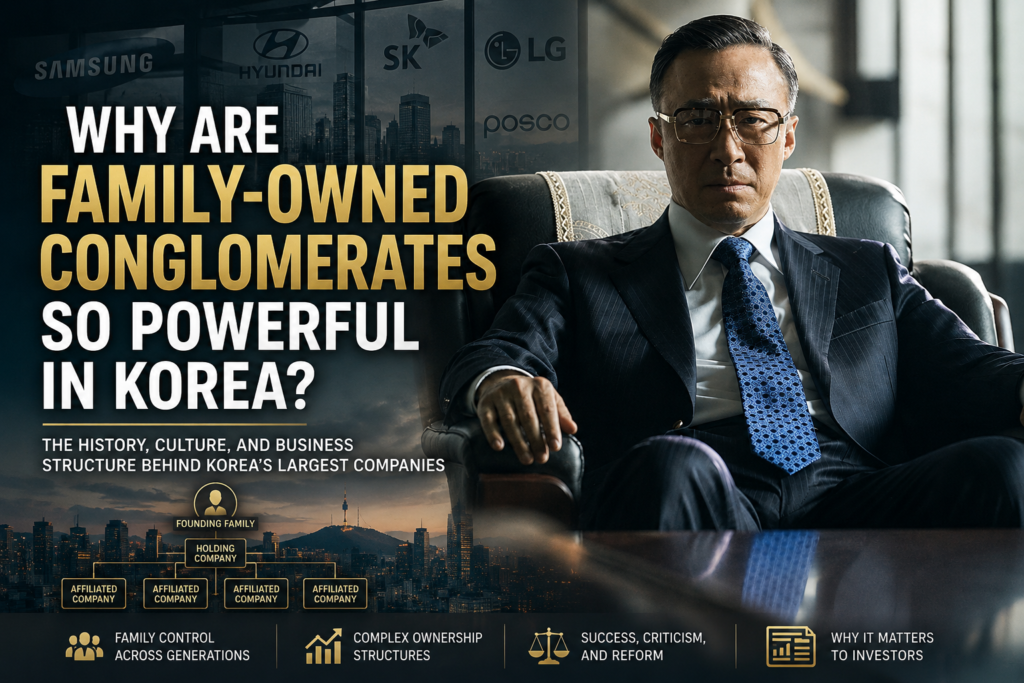
The History, Culture, and Business Structure Behind Korea’s Largest Companies
When people think about South Korea, they usually think of global brands like Samsung, Hyundai, LG, and SK.
These companies have become household names around the world.
What surprises many foreign visitors is not only how large these companies are, but how many of them are still influenced by the families that founded them decades ago.
In many Western countries, ownership and management are often separated. Professional executives manage the company, while shareholders own the business.
South Korea developed differently.
Many of its largest companies remain part of family-controlled business groups known as chaebols.
Why did this happen?
And why does this system still matter today?
To answer these questions, we need to look at Korea’s modern history, corporate culture, ownership structure, and stock market behavior.
Korea’s Economic Miracle Shaped Its Corporate Structure
South Korea’s corporate structure did not appear overnight.
It was shaped by one of the fastest periods of economic growth in modern history.
After Japanese colonial rule ended in 1945, Korea faced the difficult task of rebuilding its economy. Just a few years later, the Korean War caused even greater destruction.
By the early 1960s, South Korea remained one of the poorest countries in the world.
The government believed rapid industrialization was the fastest way to improve people’s lives.
Instead of supporting every business equally, policymakers focused on companies that had the potential to compete in global markets.
These companies received financial support, infrastructure, export incentives, and opportunities to expand into strategic industries.
Over time, they moved into electronics, automobiles, shipbuilding, construction, chemicals, finance, and many other industries.
Many of today’s largest chaebols were built during this period.
South Korea’s rapid economic development later became known as the “Miracle on the Han River.”
Family Leadership Became Part of the Business Model
As these companies grew larger, one characteristic became clear.
The founding families continued to lead the business.
For many founders, the company represented far more than money.
It represented years of sacrifice, entrepreneurship, and national rebuilding.
Passing leadership to the next generation was often viewed as protecting the company’s long-term vision.
This was also influenced by Korea’s traditional culture, where family continuity and long-term responsibility have historically been valued.
As a result, many of Korea’s largest companies remained under family influence even after becoming global corporations.
This is one of the biggest differences between Korean chaebols and many Western corporations.
Family Control Does Not Always Mean Majority Ownership
One of the biggest misunderstandings about Korean chaebols is that founding families own most of their companies.
In reality, this is often not true.
Many founding families own only a relatively small percentage of shares in key companies.
Instead, control is often maintained through affiliated companies, holding companies, cross-shareholding structures, and voting rights.
For foreign investors, this structure can seem unusually complicated.
However, understanding this system helps explain why a family can continue leading an entire business group without owning a majority of its shares.
In Korea, control is not always about owning the largest number of shares.
It is often about controlling the structure.
Why Did Korean Society Accept This System?
The answer is closely connected to South Korea’s economic history.
For much of the second half of the twentieth century, economic growth was one of the country’s highest national priorities.
Millions of people experienced dramatic improvements in their quality of life within a single generation.
Household incomes increased.
Education became more accessible.
Modern cities were built.
Korean products began competing around the world.
As chaebols expanded globally, they created millions of jobs and became symbols of Korea’s economic success.
Because of these achievements, many Koreans viewed the success of major business groups as closely connected to the country’s own success.
This does not mean everyone supported every aspect of the chaebol system.
However, during a period when rapid development was the highest priority, economic growth often received greater attention than corporate governance.
Why Do Succession Issues Often Affect Korean Stock Prices?
One important feature of Korea’s family-controlled business groups is that leadership succession can become a major market event.
In companies led entirely by professional managers, leadership changes are often viewed mainly as management decisions.
In Korean chaebols, succession can affect ownership structures, voting power, governance, and long-term group strategy.
This is why investors pay close attention to inheritance taxes, ownership restructuring, and changes in shareholding among family members.
Succession-related issues can sometimes place downward pressure on stock prices when uncertainty increases.
In other cases, family disputes or restructuring expectations can cause sharp price movements.
Sometimes stocks rise when investors expect governance reform, asset sales, or a change in control.
Sometimes stocks fall when investors worry about family conflict, unclear succession plans, or decisions that may not benefit minority shareholders.
This is one reason Korean stocks can behave differently from what foreign investors might expect.
Earnings are important.
But in Korea, ownership structure and succession can also matter a great deal.
For long-term investors, understanding succession issues can be just as important as analyzing earnings reports.
Korea’s View of Chaebols Is Changing
As South Korea became one of the world’s leading economies, public expectations also changed.
Today, people expect large companies to be successful, but they also expect them to operate responsibly.
Corporate governance has become a much more important topic.
Shareholders are asking for greater transparency.
Institutional investors are paying closer attention to board independence and executive accountability.
Government policies have also evolved to strengthen fair competition and improve corporate governance.
In recent years, discussions about shareholder rights, succession planning, and governance reform have become increasingly common.
The debate today is no longer about whether chaebols should exist.
Instead, it is about how these companies can remain globally competitive while becoming more transparent and accountable.
Why Does This Matter to Foreign Investors?
If you invest in South Korea, understanding chaebols can help you better understand the market.
Many of Korea’s largest listed companies belong to major business groups.
News about leadership succession, corporate restructuring, governance reform, or shareholder activism can influence investor sentiment.
Without understanding how chaebols operate, these stories may seem confusing.
However, once you understand how Korea’s business groups are organized, many headlines become much easier to interpret.
This is especially important because Korean companies are often valued not only by their profits, but also by their governance structure, ownership issues, and discount factors.
This is sometimes connected to what investors call the “Korea Discount.”
Conclusion
Family-controlled conglomerates remain one of the defining features of South Korea’s economy.
Their influence reflects decades of economic development, historical circumstances, business evolution, and ownership culture.
Without chaebols, South Korea’s transformation into one of the world’s leading economies would likely have looked very different.
At the same time, Korea continues to improve its corporate governance system to meet the expectations of investors and society.
Understanding chaebols is not simply about understanding large companies.
It is about understanding Korea itself.
Quick Summary
| Question | Answer |
|---|---|
| Why are Korean conglomerates family-controlled? | They grew during Korea’s rapid industrialization while founding families continued leading the business groups. |
| Do founding families own most of the shares? | Not always. Many maintain influence through affiliated companies, holding structures, and voting rights. |
| Why did Korean society accept this model? | Because rapid economic growth, job creation, and higher living standards were national priorities for decades. |
| Why does succession affect Korean stocks? | Succession can influence ownership, governance, inheritance tax planning, and investor confidence. |
| Is the chaebol system changing? | Yes. Korea continues strengthening corporate governance, transparency, and shareholder rights. |
Frequently Asked Questions
Are all large Korean companies chaebols?
No.
Many successful Korean companies operate independently or under different ownership structures.
The term “chaebol” generally refers to large family-controlled business groups with multiple affiliated companies.
Are chaebols good or bad?
There is no simple answer.
Many people credit chaebols for helping South Korea achieve remarkable economic growth.
At the same time, concerns about governance, market concentration, succession, and transparency continue to encourage reform.
Why should foreigners learn about chaebols?
Because understanding chaebols helps explain Korea’s economy, stock market, corporate culture, and many of the country’s biggest companies.
Why do succession issues matter so much in Korea?
Because succession can affect ownership structures, inheritance taxes, family control, and the future direction of a business group.
For investors, these issues can influence stock prices as much as earnings or sales growth.