
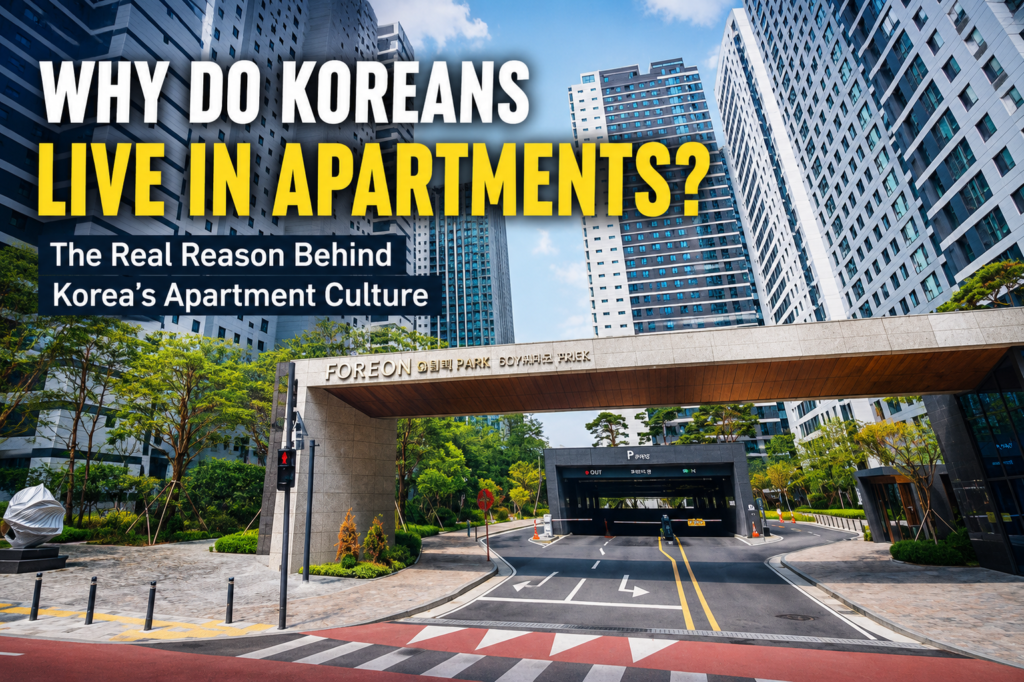
The Real Reason Apartments Dominate Korean Cities
If you visit Seoul for the first time, one thing will immediately stand out.
Apartments.
Tall apartment towers seem to stretch endlessly across the city. Many visitors expect to see them in famous districts like Gangnam, but the surprise is that apartments are everywhere.
Whether you are in northern Seoul, southern Seoul, or many surrounding cities, apartment buildings dominate the skyline.
For many foreigners, the question comes naturally:
Why do so many Koreans live in apartments?
The answer has less to do with architecture and more to do with Korea’s history, geography, and culture.
Korea Urbanized at an Extraordinary Speed
To understand Korean apartments, you first need to understand how quickly Korea changed.
In the 1960s, South Korea was still a largely rural country. Many people lived in villages and worked in agriculture.
Then everything changed.
As factories, businesses, and jobs concentrated in cities, millions of people moved from rural areas to urban centers, especially Seoul.
Korea’s population was also growing rapidly during this period. People born around 1958 are often jokingly referred to as part of Korea’s “baby boom generation,” a group that witnessed the country’s transformation from poverty to prosperity.
The challenge was simple.
Millions of people needed homes.
And they needed them quickly.
Apartment buildings became the most efficient solution.
In fact, when Korea’s first large apartment complexes were built, they were often featured on television and promoted as symbols of a modern future. At the time, they represented a completely new way of living.
Korea Has Less Buildable Land Than Many People Realize
Another important reason is geography.
About 70% of South Korea is covered by mountains.
Many foreign visitors notice this almost immediately.
A friend once told me that one of the most surprising things about Korea was seeing mountains everywhere. Even while traveling through Seoul, one of the world’s largest cities, mountains are always visible in the background.
Korea is a country where urban life and nature exist side by side.
Because flat land is limited, building upward often makes more sense than expanding outward.
In some cases, mountains were even reshaped to accommodate urban development.
For example, Seoul National University’s current campus was developed around the foothills of Gwanak Mountain, reflecting how valuable buildable land has always been in Korea.
When land is limited and the population is concentrated, high-density housing becomes a practical choice.
Apartments Became a Symbol of Modern Life
Today, an apartment may seem ordinary.
In the 1970s and 1980s, however, apartments were considered revolutionary.
Many older homes lacked modern facilities that people now take for granted.
Apartments offered:
Indoor plumbing
Modern bathrooms
Central heating systems
Elevators
Parking spaces
Better building management
For many Korean families, moving into an apartment felt like moving into the future.
Owning an apartment became associated with stability, success, and a higher standard of living.
That cultural perception still exists today.
Apartments Created Entire Communities
In Korea, apartments are rarely just buildings.
They often become the center of entire neighborhoods.
Because large numbers of people live in the same area, businesses naturally follow.
Schools, supermarkets, hospitals, cafes, restaurants, gyms, and public transportation tend to develop around major apartment complexes.
Not every apartment has everything nearby, of course.
But over time, large residential communities attract the services people need.
This creates a lifestyle that many Koreans find highly convenient.
Instead of driving long distances, daily necessities are often within walking distance.
Apartments Also Became Investments
This is where Korea becomes different from many countries.
For many Koreans, an apartment is not only a place to live.
It is also one of the most important financial assets a family can own.
Housing prices in Seoul have increased significantly over several decades, particularly in districts associated with strong schools, transportation, and employment opportunities.
Areas such as Gangnam, Jamsil, Mok-dong, Bundang, Yongsan, and Hannam-dong are often discussed not only as residential areas but also as investment locations.
As a result, apartments became deeply connected to wealth creation and social mobility.
In Korea, conversations about housing are often conversations about economics.
The Eunma Apartment Story
One famous example is Eunma Apartment in Daechi-dong, Seoul.
Completed in 1979, the complex is now more than 40 years old.
In many countries, an apartment complex of that age might be considered outdated.
Yet Eunma Apartment remains one of the most talked-about residential complexes in Korea.
Many foreigners find this surprising.
How can a decades-old apartment still command such high prices?
The answer lies in location, education, transportation, redevelopment expectations, and the long-standing belief that real estate can preserve and build wealth.
The story of Eunma Apartment is, in many ways, the story of modern Korean housing.
Why Foreigners Often Find This Strange
Many Americans look at Korean cities and wonder:
“Why do all the buildings look so similar?”
Many Europeans ask:
“Why don’t Koreans preserve older residential buildings?”
These are reasonable questions.
But Koreans often evaluate housing differently.
Efficiency matters.
Education matters.
Transportation matters.
Convenience matters.
Being close to a good school, subway station, or workplace is often more important than living in a unique or historic building.
Different societies develop different housing priorities.
Korea’s apartment culture reflects its own history and values.
Final Thoughts
The reason Koreans live in apartments is not simple.
Rapid industrialization, limited land, urban concentration, educational opportunities, and investment culture all played important roles.
As a result, apartments became much more than places to live.
They became symbols of opportunity, stability, education, and success.
Even today, many people living outside Seoul still dream of owning just one apartment in the capital.
That dream says a lot about modern Korea.
To understand Korean apartments is to understand an important part of Korean society itself.